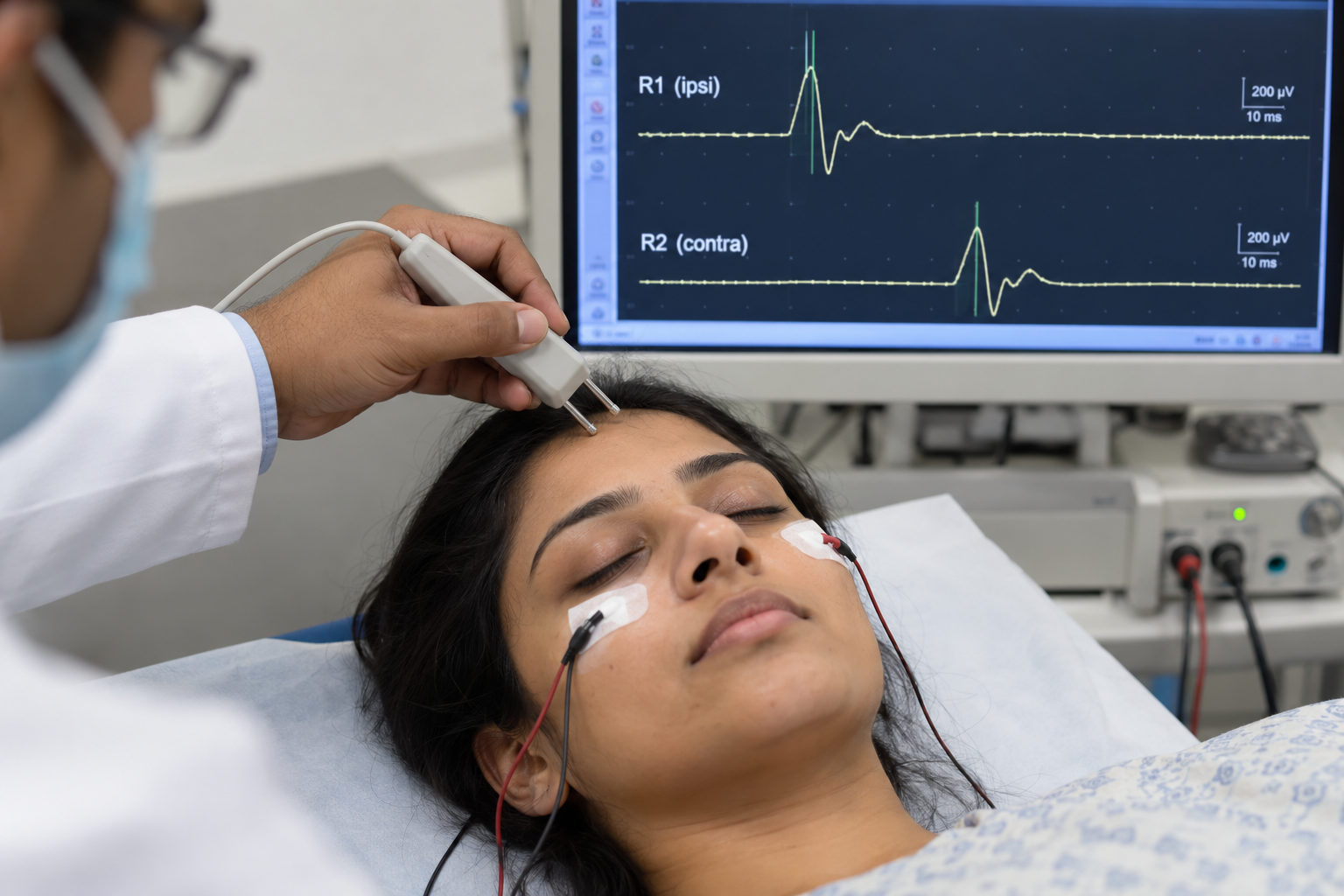
The Blink Reflex Study is a nerve test that checks the reflex pathway behind blinking. It assesses the trigeminal nerve, which carries sensation from the face, the facial nerve, which controls the muscles that close the eye, and the connections between them in the brainstem.
A small electrical pulse is given over the forehead, just above the eyebrow, and electrodes under both eyes record the blink response. The test helps neurologists find where along this pathway a problem lies.
Consult Dr. Soumya Arapreddy, MD, DM Neurology, Consultant Neurologist, for Blink Reflex Studies in Hyderabad.
You lie down comfortably with your eyes gently closed. Small sticker electrodes are placed below both eyes and on the nose or cheek. A brief, mild electrical pulse is given over the nerve just above one eyebrow, and then the other side is tested.
Each pulse produces a reflex blink. The machine records two parts of the response: an early response (R1) on the same side, and a later response (R2) on both sides. The test usually takes 15–30 minutes and is often done along with facial nerve conduction studies.
Yes. The test uses very small electrical pulses through surface electrodes. You will feel a quick tap on the forehead and a blink. There are no needles, and you can return to your routine immediately.
By comparing the timing of R1 and R2 on both sides, the neurologist can tell whether a problem lies in the trigeminal nerve, the facial nerve or the brainstem. For example, in Bell’s palsy the responses are delayed or absent on the affected side. These findings also help track recovery over time.
Dr. Soumya Arapreddy, MD, DM Neurology, is a highly dedicated Consultant Neurologist offering advanced neurological care for stroke, paralysis, headaches, epilepsy, neuropathy, migraine, movement disorders, and other neurological conditions.
With expertise in modern neurology and compassionate patient care, she focuses on providing accurate diagnosis and personalized treatment for every patient.
Visit CANES Clinic in Hyderabad for advanced brain stroke treatment, paralysis treatment, and comprehensive neurological care under the guidance of Dr. Soumya Arapreddy.
CANES Clinic offers specialized neurological services for patients in Kondapur, Hitech City, Manikonda, Gachibowli, Madhapur, Kukatpally, and nearby areas. Visit our clinic today for expert neuro care and advanced stroke management.
Our construction business is dedicated to delivering high-quality, innovative building solutions, every project is completed
08106874654
arapreddysoumya@gmail.com
Address: 3rd Floor, Tapasavi Commercial Complex, Hitension Rd, Kondapur, Raghavendra Colony, Gachibowli, Hyderabad, Telangana 500084
Copyright © 2026 All Right Reserved